Influences and Mentors in Early Life
Adrian Frutiger was born in Switzerland in 1928, where he grew up in a family full of craftsmanship. When he was young, his family moved so his father could open a handloom workshop. The handloom shop exposed young Frutiger to an array of machines awakening his interest in all things mechanical and electrical. This would later influence and shape his future design thinking.3, 6
Frutiger began school in 1935 and was initially apathetic to the concept. This changed during his adolescent years when he developed a love for reading, drawing, and painting. He was enamored by the hand drawn illustrations of Ernst Eberhard’s children's books. Eberhard’s stories captivated Frutiger so much that he wrote to the author; this led to the two developing a mentor and student relationship. Eberhard encouraged Frutiger to observe nature closely and refine his artistic skills. Frutiger was also deeply inspired by literature due to the influence of his former primary school teacher Franz Knuchel and his wife Leny, whom he developed a friendship with. Through their encouragement, he began reading classical works, particularly those by Herman Hesse, which left a lasting impression on his thinking and creativity.6
As he approached the end of secondary school, Frutiger’s interest in type began to take shape. He rejected the rigid and standardized handwriting styles taught in schools at the time and instead experimented with his own more fluid and expressive style. By age 15, he had decided to pursue a creative career. This was met with resistance from his father, who encouraged him to learn practical skills because of economic uncertainty. Frutiger did consider this briefly, but his mentor Ernst Eberhard guided him towards a more creative path—an apprenticeship in typesetting at a print company. During this time, Frutiger attended trade school where his teacher Walter Zerbe helped ground him in the technical and structural foundations of typesetting. He produced early works of carefully crafted books that combined text and illustrations. After completing his apprenticeship, he continued working briefly in Zurich while aiming to further his education.6
In 1949 this aim came to fruition for Frutiger as he entered the School of Arts and Crafts (Kunstgewerbeschule) in Zurich, where he deepened his understanding of typography under his teachers like Alfred Willimann and Walter Käch.Willimann, who was mostly self-taught, introduced Frutiger to the expressive and structural quality of calligraphy emphasizing the–
rhythm of strokes and the quality of whitespace, “For Alfred Willimann the essence of calligraphy was not building up the black, but rather covering the white, so that the light of the white page remains alive.”6 Käch studied for several years to graduate from a graphic design course, and in even more contrast to Willimann, focused on the practicality and readability of calligraphy. In addition to earlier influences like Ernst Eberhard and Franz Knuche, these mentors and influences shaped Frutiger’s understanding of typography as both an artistic and functional practice, laying the foundation for his future success as a typographer.3, 6
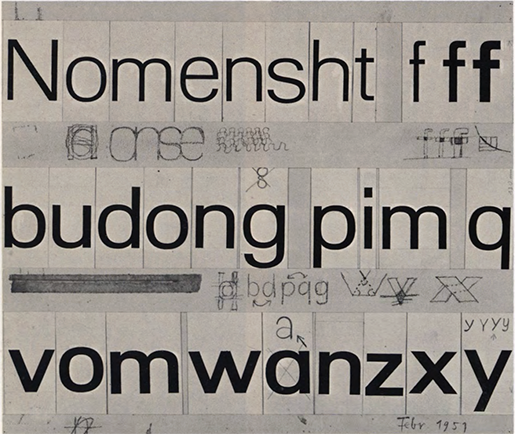
Frutiger’s typeface drawings from his time at Kunstgewerbeschule in 1949. You can see the foundation of Univers starting to be formed. From Type, Sign, Symbol by Adrian Frutiger et al. 3 p. 12.